




What is slippage in crypto?

Slippage can change how much crypto you receive from a swap. Learn why it happens, how it affects your trade and how to reduce the risk before confirming a transaction.
If you’ve ever confirmed a token swap and received a slightly different amount than the quote, you’ve seen slippage in action. It is the difference between the price you see when placing a swap and the price at which the transaction is completed on-chain.
That difference matters. Slippage can reduce your final output, cause a transaction to fail or make a trade feel worse than expected. The good news: you can manage it by understanding what causes slippage, how it differs from price impact and when to adjust your settings instead of forcing a swap through.
What is slippage in crypto?
Slippage in crypto is the difference between the output you expected when you submitted a trade and the output you actually received when it executed.
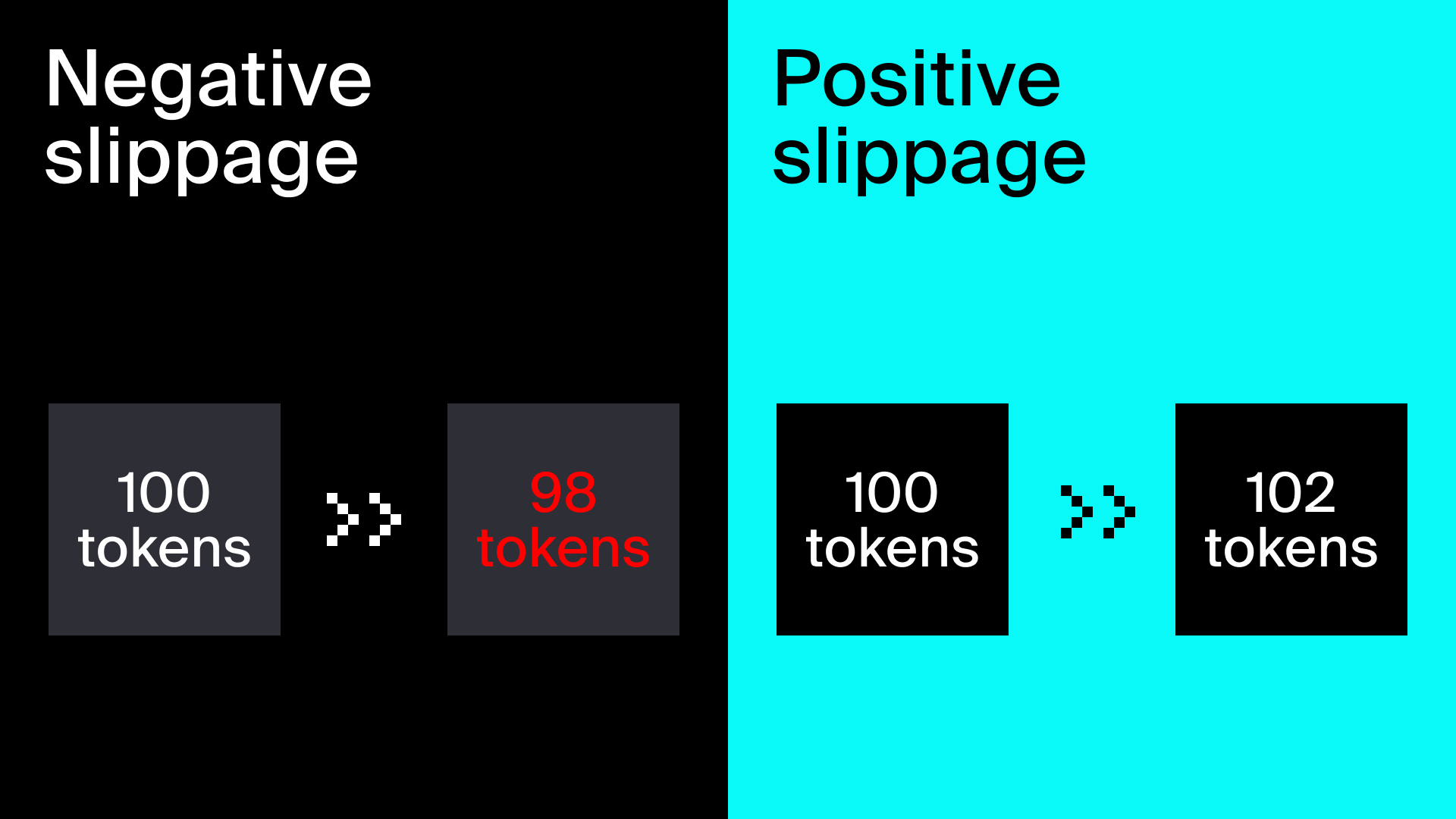
That difference can go in either direction:
- Negative slippage means you received a worse result than expected.
- Positive slippage means the market moved in your favor, and you received a better result than expected.
Slippage is not a hidden fee or a network commission. It is simply a market effect that happens when prices move, liquidity is thin, or your trade takes time to finalize on the blockchain.
Why your swap output changes
There are four common reasons your swap output changes between the initial quote and final execution.
1. The market moved before confirmation
Crypto prices can change in seconds. If the broader market moves between the moment you sign the transaction and the moment it confirms, the final amount can change too. This is one of the most common causes of slippage in fast-moving, highly volatile markets.
2. Liquidity was too thin
If there is not enough liquidity near your quoted price in a specific pool, your trade may have to fill across worse levels to complete. That is why slippage is usually more noticeable on smaller, newer, or highly volatile tokens.
3. Your trade size moved the market
Large swaps can affect the price while they execute. In DeFi, the sheer size of your own order can worsen the rate you receive if the market is shallow.
4. Network delay gave the price more time to move
On-chain execution is not instant. If the network is heavily congested or your transaction waits longer than expected in the mempool, the market has more time to shift before your swap officially completes.
Slippage vs. price impact
These are related concepts, but they are not the same thing. Understanding the difference is critical for protecting your funds.
- Price impact is the direct effect of your own trade's size on the market price of the pair.
- Slippage is the difference between the quoted result and the final executed result caused by external market movement and time delay.
That distinction matters because a user can experience meaningful price impact from a large order, slippage from market movement during execution, or both at the exact same time. For a deeper technical breakdown of how to navigate this, read the official Help Center guide on price impact vs. price slippage.
What is slippage tolerance?
Slippage tolerance is the maximum price deviation you are willing to accept before a swap fails, preventing it from completing at a worse result.
On 1inch, slippage tolerance is set as a percentage of the total swap value. If the returned token amount falls outside that allowed range between submission and confirmation, the smart contract safely reverts the transaction. Because market conditions constantly change, there is no single perfect setting for every swap.
What happens if your slippage tolerance is too high or too low?
If your slippage tolerance is too high, the trade may still complete during sharp price movement, but you leave more room for a poor fill. Setting tolerance too high may increase exposure to MEV-related risks such as front-running and sandwich attacks, particularly in highly liquid markets.
If your slippage tolerance is too low, the transaction may fail if the price moves even slightly beyond your limit. While this protects you from a worse fill, you will still lose the network gas fee on the failed transaction. Failed swaps often display errors such as “Min return not reached” or “Exchange Rates Expired.”
How to reduce slippage on a crypto swap
You usually cannot remove slippage completely in live markets, but you can actively reduce your exposure to it.
- Trade more liquid pairs: Deeper liquidity usually means less price movement during execution.
- Avoid sharp volatility when possible: If a token is moving aggressively, the gap between quote and execution is more likely to widen.
- Reduce order size if needed: A smaller trade is less likely to worsen its own execution. You can manually reduce price impact by reducing the amount swapped.
- Check whether the issue is slippage or price impact: If the “receive” amount looks too far from the market rate, stop and reassess instead of just raising your slippage tolerance. Always verify that the amount in the receive section matches the current market rate.
Practical takeaway
If your swap output changes, it does not automatically mean something is broken. Most of the time, the market moved, liquidity was limited, your trade size affected the route, or your slippage settings did not match the current market conditions.
The practical habit is simple: check the expected receive amount, compare your slippage with the expected price impact, avoid forcing illiquid trades through, and use stricter settings only when the market conditions support them.
Frequently Asked Questions (FAQ)
What is slippage in crypto?
Slippage is the difference between the quoted trade result and the final executed result. It can be positive or negative depending on how the price moves before execution on the blockchain.
Is slippage always bad?
No. Negative slippage means a worse result than expected, while positive slippage means a better one.
What is slippage tolerance?
Slippage tolerance is the maximum price movement you are willing to accept before a swap fails, preventing the transaction from executing at a worse result.
Why did my swap fail?
A common reason is that the market moved beyond your slippage tolerance before the transaction was confirmed. Low liquidity, high volatility, internal-commission tokens, and expired rates can also contribute to failed transactions. For step-by-step troubleshooting, consult the 1inch Help Center.
Is slippage the same as a network fee?
No. Network fees (gas) are paid to the network validators to process the transaction on-chain. Slippage refers exclusively to the difference between the quoted result and the final executed result of the tokens being swapped.
Can I avoid slippage completely?
Not usually. In live, decentralized markets, some price movement risk remains. You can reduce exposure by using more liquid pairs, keeping tolerance disciplined, and exploring intent-based execution methods like 1inch intent-based swaps, which are designed to reduce mempool exposure. As with all on-chain activity, results may vary depending on market conditions.
For more insights from 1inch subscribe to our newsletter
Share the article


 Copy done!
Recent Posts
1inch relaunches DeFi Academy
DeFi shouldn’t feel scary or complicated. The updated 1inch DeFi Academy helps you understand key concepts, make better decisions and move through DeFi with more confidence.
Liquidity in DeFi: what it is and why it matters
Liquidity shapes the price, speed and execution quality of crypto swaps. Learn how it works so you can trade with fewer surprises and better execution.
What Is DeFi? How decentralized finance actually works
DeFi enables on-chain swapping, borrowing and earning through smart contracts, without relying on traditional financial intermediaries.
