




Liquidity in DeFi: what it is and why it matters

Liquidity shapes the price, speed and execution quality of crypto swaps. Learn how it works so you can trade with fewer surprises and better execution.
If you’ve ever tried to swap a token and received a worse rate than expected, liquidity was probably part of the reason. In DeFi, liquidity determines how easily an asset can be bought or sold without moving its price too much.
That matters because liquidity directly affects slippage, price impact and execution quality. Once you understand how it works, you can make smarter trading decisions and avoid unnecessary costs.
What is liquidity in DeFi?
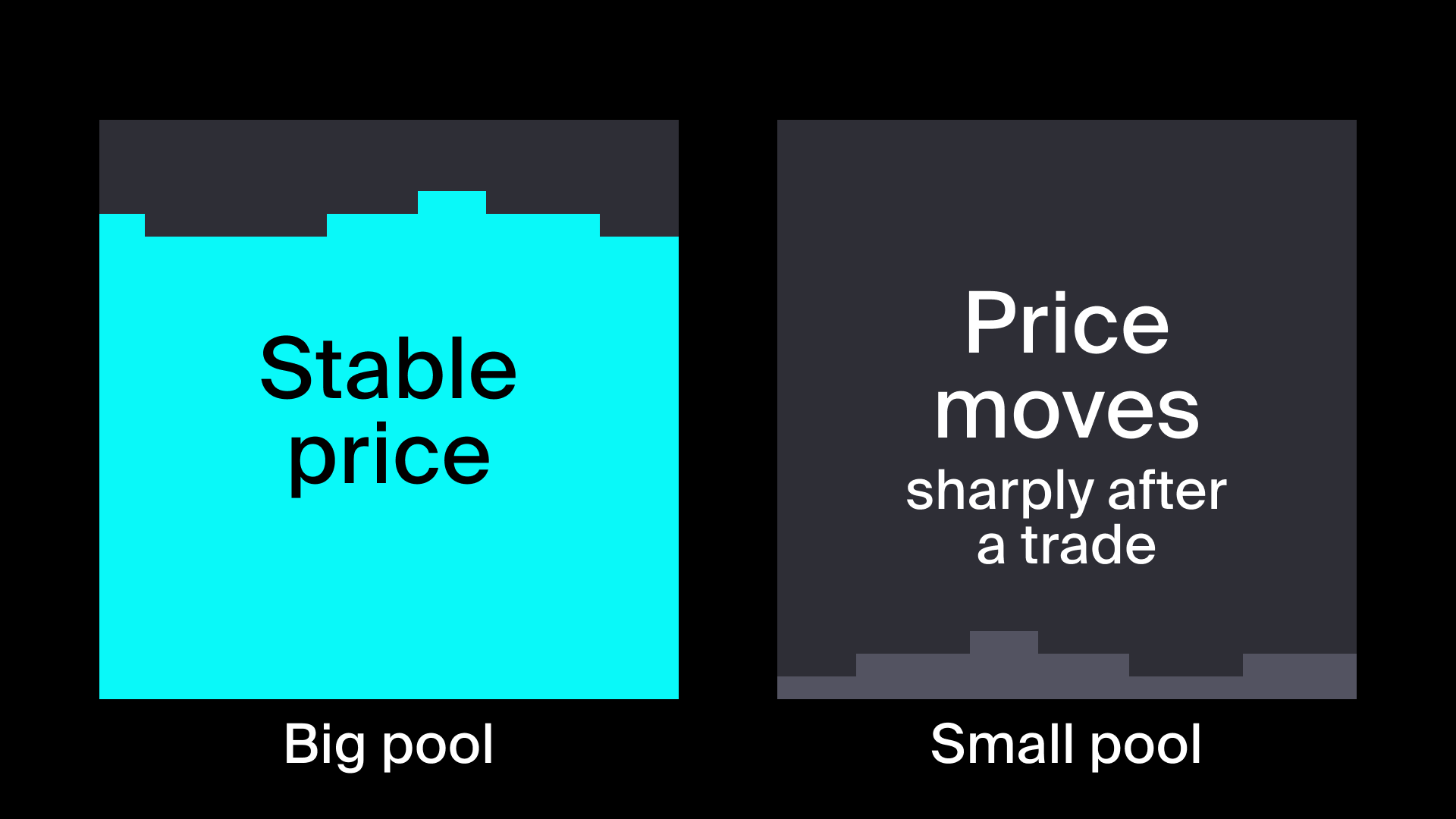
Liquidity in DeFi refers to how easily a token can be bought or sold without causing a large change in its price.
High liquidity means:
- Trades execute smoothly
- Prices remain stable
- Large orders can be processed efficiently
These are general tendencies - market conditions can change rapidly even in high-liquidity environments.
Low liquidity means:
- Prices can move sharply
- Trades may execute at worse rates
- Transactions can fail
Liquidity is not a fee or a setting - it is a property of the market itself.
How liquidity works in DeFi
Unlike traditional markets, many DeFi platforms rely on liquidity pools instead of order books.
What is a liquidity pool?
A liquidity pool is a smart contract that holds tokens deposited by users (liquidity providers).
These tokens are used to:
- Enable swaps
- Provide market depth
- Facilitate trading without intermediaries
Prices are determined algorithmically based on the balance of assets in the pool.
Who provides liquidity?
Liquidity in DeFi is supplied by users called liquidity providers (LPs).
They deposit token pairs into pools and, in return:
- Earn a share of trading fees
- Help maintain market functionality
However, providing liquidity involves risks, including impermanent loss - a situation where the value of deposited assets may be lower upon withdrawal compared to simply holding them. Users should research LP mechanics thoroughly before depositing funds.
Why liquidity matters for your swaps
Liquidity directly affects how your trade executes.
1. Better prices
Deep liquidity means your trade can be executed close to the market price.
2. Lower slippage
When liquidity is high, price movement during execution is minimal.
3. Reduced price impact
Large trades in shallow markets can move prices significantly. Deep liquidity reduces this effect.
4. Higher success rate
Low liquidity can cause transactions to fail if there is not enough depth to complete the trade.
What happens when liquidity is too low?
Low liquidity introduces several risks:
- Higher slippage: worse execution than expected
- Price volatility: even small trades can move the market
- Failed transactions: insufficient liquidity to complete swaps
- Increased MEV exposure: thin markets are easier to exploit
This is why trading on illiquid pairs often leads to poor outcomes.
Liquidity vs. volume
These terms are related but not the same.
- Liquidity: how much capital is available for trading
- Volume: how much trading activity occurs
A market can have:
- High volume but low liquidity (volatile conditions)
- High liquidity but low volume (stable but inactive market)
Understanding the difference helps explain why some markets behave unpredictably.
How to identify good liquidity
Before executing a trade, check:
- Size of the liquidity pool
- Difference between expected and received amount
- Price impact indicators
- Overall market activity
If the numbers look off, reconsider the trade instead of forcing it through.
How to trade more efficiently
You cannot control liquidity, but you can adapt to it.
- Trade more liquid pairs
- Avoid large trades in shallow markets
- Monitor price impact before confirming
- Use aggregation tools to access deeper liquidity
These habits help reduce unnecessary losses.
Practical takeaway
Liquidity is one of the most important factors in DeFi trading.
If liquidity is high, trades are generally smoother and more efficient.
If liquidity is low, execution becomes riskier and more costly.
The practical habit is simple: check liquidity before trading, avoid illiquid markets, and use tools that aggregate liquidity to improve execution.
Frequently Asked Questions (FAQ)
What is liquidity in DeFi?
Liquidity is the availability of assets in a market that allows trades to be executed without significantly affecting price.
Why is liquidity important?
It affects price stability, slippage, and whether your transaction can execute successfully.
What are liquidity pools?
Smart contracts that hold tokens and enable trading without intermediaries.
Who provides liquidity?
Liquidity providers - users who deposit assets into pools and earn fees.
What happens if liquidity is low?
You may experience higher slippage, worse prices, or failed transactions.
Can I improve liquidity?
You cannot directly control it, but you can trade in markets with higher liquidity.
For more insights from 1inch subscribe to our newsletter
Share the article


 Copy done!
Recent Posts
1inch relaunches DeFi Academy
DeFi shouldn’t feel scary or complicated. The updated 1inch DeFi Academy helps you understand key concepts, make better decisions and move through DeFi with more confidence.
What is slippage in crypto?
Slippage can change how much crypto you receive from a swap. Learn why it happens, how it affects your trade and how to reduce the risk before confirming a transaction.
What Is DeFi? How decentralized finance actually works
DeFi enables on-chain swapping, borrowing and earning through smart contracts, without relying on traditional financial intermediaries.
