




What Is DeFi? How decentralized finance actually works

DeFi enables on-chain swapping, borrowing and earning through smart contracts, without relying on traditional financial intermediaries.
If you’ve ever swapped tokens, earned yield or borrowed crypto from a wallet, you’ve already used decentralized finance, or DeFi. Instead of relying on banks or brokers, DeFi uses smart contracts to execute transactions transparently on a blockchain.
That shift matters. DeFi changes how value moves by letting you interact directly with code. The result is a financial system that is open, composable and accessible to anyone with a crypto wallet.
What is DeFi?
DeFi, short for decentralized finance, is a system of financial applications built on blockchain networks that operate without centralized intermediaries like banks or brokers.
Instead of accounts and institutions, DeFi relies on:
- Smart contracts to execute logic
- Liquidity pools to facilitate trading and lending
- Wallets to give users direct control over funds
In practice, this means you can:
- Swap tokens
- Lend and borrow assets
- Earn yield
- Provide liquidity
In most DeFi interactions, you retain direct control of your funds through your wallet, without transferring custody to a centralized third party. Individual protocols may vary.
How DeFi actually works
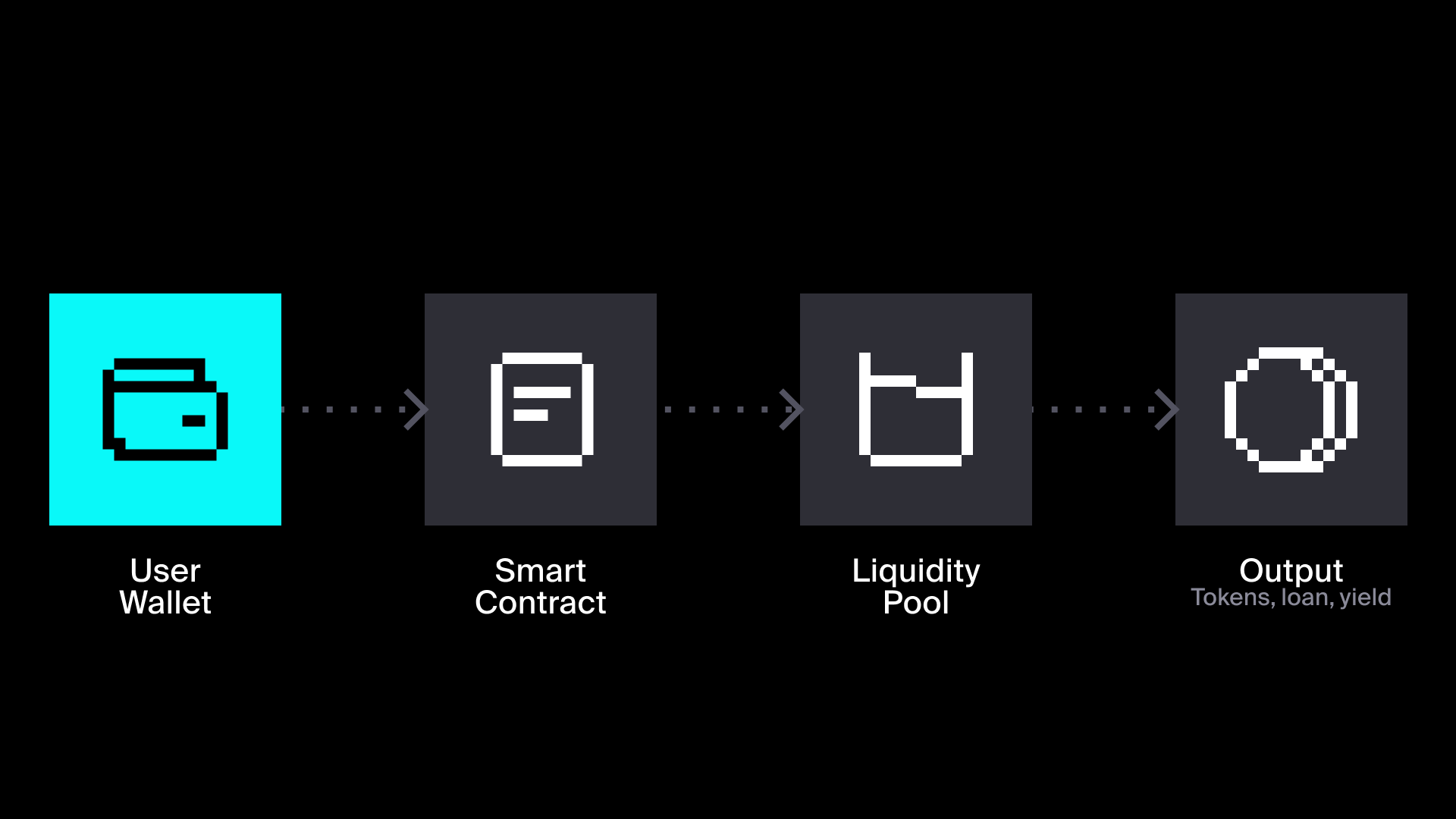
DeFi works by combining smart contracts with on-chain liquidity and user-controlled wallets.
1. Smart contracts replace intermediaries
Smart contracts are self-executing programs deployed on a blockchain. They define the rules of a financial interaction and automatically enforce them.
For example:
- A lending protocol locks collateral and issues a loan
- A swap contract exchanges tokens at a market rate
- A yield strategy distributes rewards based on participation
Once deployed, these contracts are designed to execute according to their coded logic.
2. Liquidity pools power markets
Instead of traditional order books, many DeFi platforms use liquidity pools.
Users deposit tokens into pools, and those funds are used to:
- Enable token swaps
- Facilitate borrowing
- Provide market depth
Prices are determined algorithmically, based on supply and demand within the pool.
3. Users interact via wallets
In DeFi, your wallet is your account.
You connect a wallet (like MetaMask or hardware wallets) to a dApp and:
- Approve transactions
- Sign messages
- Retain full control of your funds
There are no usernames, passwords, or custodians holding your assets.
What can you do in DeFi?
DeFi covers a wide range of financial use cases.
Token swaps
Users can exchange one token for another directly on-chain using decentralized exchanges (DEXs).
Lending and borrowing
You can:
- Deposit assets to earn interest
- Borrow against collateral without selling your holdings
All terms are enforced by smart contracts.
Yield generation
Users can earn rewards by:
- Providing liquidity
- Staking tokens
- Participating in incentive programs
Payments and transfers
DeFi enables fast, global transfers without relying on banks or payment processors.
Why DeFi exists
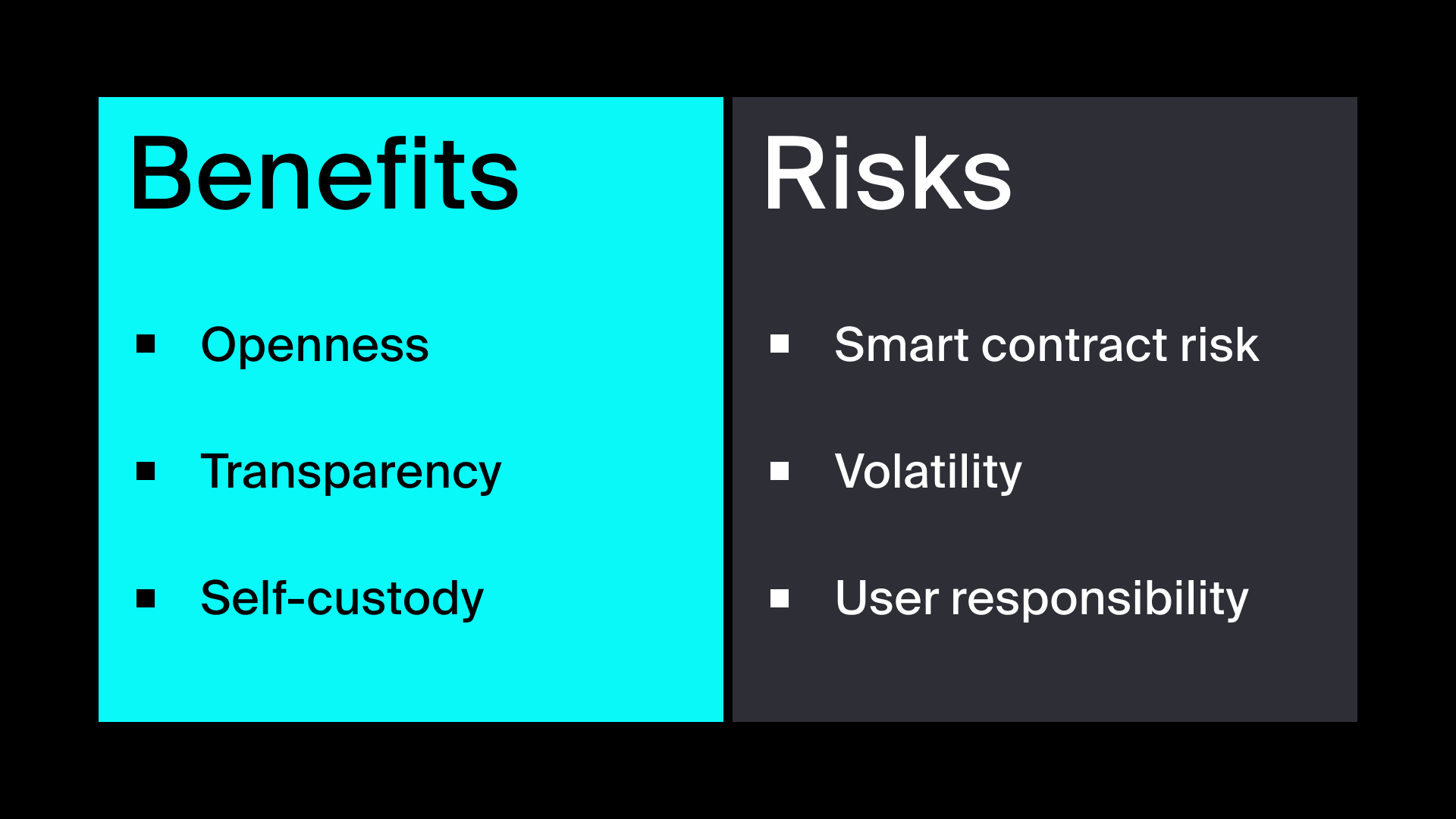
DeFi emerged to solve limitations in traditional finance:
- Restricted access: Many financial services are not globally available
- Lack of transparency: Users cannot verify how systems operate
- Intermediary risk: Funds depend on third-party custody
DeFi addresses these by offering:
- Open access
- On-chain transparency
- Self-custody
Risks and limitations of DeFi
DeFi is powerful, but not risk-free.
Smart contract risk
Bugs or vulnerabilities in code can lead to loss of funds.
Market volatility
Crypto markets can move quickly, affecting collateral and swap outcomes.
Liquidity risk
Low liquidity can lead to poor execution or higher price impact.
User responsibility
There is no customer support reversing transactions. Users must manage their own security and decisions.
How to start using DeFi
Getting started is straightforward:
- Create a crypto wallet
- Fund it with assets
- Connect to a DeFi application
- Start with simple actions like swaps
Always verify:
- The application you are using
- The token addresses
- The transaction details before signing
Frequently Asked Questions (FAQ)
What is DeFi in simple terms?
DeFi is a system of financial services built on blockchain networks that operate without banks or centralized intermediaries.
Is DeFi safe?
It can be, but it depends on the protocol, smart contract security, and user behavior. Risks include bugs, volatility, and user error.
Do I need to create an account to use DeFi?
No. You only need a crypto wallet. There are no traditional accounts or intermediaries.
How does DeFi make money?
Users can earn through trading, lending, staking, or providing liquidity. Protocols may generate fees from activity.
What is the difference between DeFi and CeFi?
DeFi is non-custodial and runs on smart contracts. CeFi (centralized finance) relies on institutions that control user funds.
Can I use DeFi without technical knowledge?
Yes. Many interfaces are designed for everyday users, though understanding basic concepts helps reduce risk.
For more insights from 1inch subscribe to our newsletter
Share the article


 Copy done!
Recent Posts
1inch relaunches DeFi Academy
DeFi shouldn’t feel scary or complicated. The updated 1inch DeFi Academy helps you understand key concepts, make better decisions and move through DeFi with more confidence.
Liquidity in DeFi: what it is and why it matters
Liquidity shapes the price, speed and execution quality of crypto swaps. Learn how it works so you can trade with fewer surprises and better execution.
What is slippage in crypto?
Slippage can change how much crypto you receive from a swap. Learn why it happens, how it affects your trade and how to reduce the risk before confirming a transaction.
