



Staying safe from slippage

This post explains the risk of slippage and ways to minimize it.
Typical of automated market makers (AMMs) and decentralized exchanges (DEXes), slippage is the difference between the requested or expected price of an order and the price at which the order is actually executed.
Slippage occurs when an asset’s price quickly changes, basically reflecting that asset’s price movement determined by its available liquidity and trading activity in the market. The lower liquidity or higher trading activity, the higher slippage, which is normally shown as percentage of a trade’s value. For volatile or low-liquidity tokens, that percentage could reach 10% or more.
Incidentally, slippage is not always a bad thing. Sometimes, the price at which an order is filled may actually be more favorable than what the user expected. That is called positive slippage. However, positive slippage is less common than negative slippage.
To protect users from losing substantial funds because of slippage, exchanges provide users with an opportunity to set the maximum size of slippage they agree to — normally referred to as slippage tolerance.
If a user sets slippage tolerance at 1% for an order worth $100,000, that means they would agree to pay no more than $101,000 for the entire order, and it wouldn’t be filled at a higher price.
Still, while setting slippage tolerance, users should consider the fact that a transaction with a very low slippage value may fail.
Meanwhile, 1inch makes sure that users — crypto novices and seasoned pros alike — shouldn’t worry about the slippage issue.
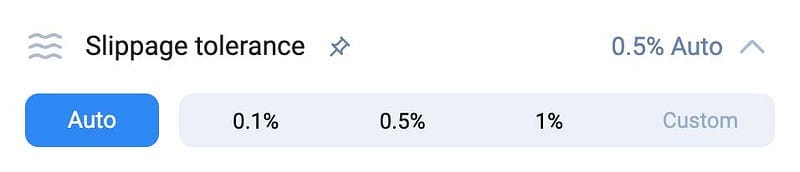
Users making swaps via 1inch can choose between the slippage tolerance options of 0.1%, 0.5% and 1%. They can also select their own value for slippage tolerance by clicking the Custom button.
In addition, for all swaps on the Ethereum network (and, moving forward, on other chains, as well) the auto-slippage mode can be activated, in which the most optimal slippage value is selected.
As a result, a user’s transaction will be protected from substantial losses due to slippage, as well as from front-running, while, on the other hand, there will be a high probability that the transaction will be executed successfully.
If a user mistakenly sets a too low or too high slippage value, the web app’s interface will warn them about possible risks.
To adjust slippage tolerance, a user needs to click the swap settings button in the upper right corner of the swap screen. Users can also pin the slippage tolerance bar to see it at each swap.
Overall, slippage is an issue that DEX users are inevitably faced with. But by selecting platforms that protect users from slippage, it is possible to significantly minimize that risk.
Stay tuned to learn more about various aspects of DeFi.
Share the article


 Copy done!
Recent Posts
How to use 1inch Wallet: a step-by-step guide
Get started with self-custody in minutes. Learn how to create a wallet, manage assets and interact with DeFi - all in one place.
What is the CLARITY Act?
The CLARITY Act could give US crypto its clearest rulebook yet. The bill aims to define who oversees digital assets, how crypto businesses must operate and what protections consumers should expect.
RWA trade sizes near-doubles
In April, the average RWA swap size on 1inch rose by roughly 91%, pointing to larger on-chain capital allocation.
